Forging vs. Casting: A Comprehensive Comparative Analysis
Forging vs. Casting: A Comprehensive Comparative Analysis
Executive Summary
Metal forming stands at the heart of modern manufacturing, with forging and casting representing two fundamentally different approaches to shaping metal components. While both processes have been refined over centuries of industrial development, they operate on distinct principles that result in significantly different material properties, capabilities, and applications.
Forging manipulates metal while it remains in a solid state, using compressive forces to reshape the material. Casting, conversely, transforms metal into a liquid state, pouring it into molds where it solidifies into the desired form. This fundamental difference in processing methodology creates cascading effects throughout the material structure, mechanical properties, and ultimate performance characteristics of the finished components.
Understanding these differences is crucial for engineers, designers, and procurement professionals who must make informed decisions about manufacturing processes. The choice between forging and casting can significantly impact product performance, longevity, cost-effectiveness, and production feasibility.
1. Process Fundamentals
The Nature of Metal Transformation
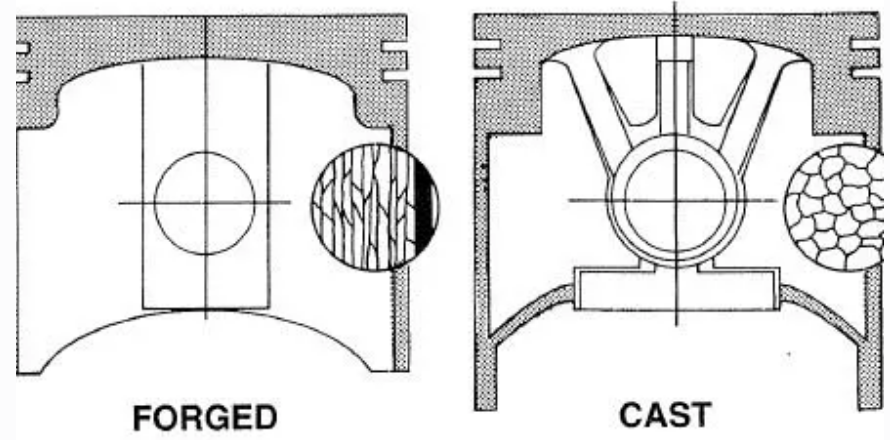
The distinction between forging and casting begins at the atomic level. When metal is forged, its crystalline structure is compressed and refined while remaining solid. The mechanical forces applied during forging align the grain structure along stress lines, creating what metallurgists call “flow lines” that follow the contours of the part. This grain flow acts similarly to the grain in wood, providing directional strength where it’s most needed.
Casting takes a different approach entirely. By melting the metal, all previous grain structure is eliminated. As the molten metal cools within the mold, new grains form and grow. Without the directional pressure of forging, these grains develop more randomly, creating a more isotropic (uniform in all directions) but less refined structure.
| Process Aspect | Forging | Casting |
|---|---|---|
| Material State | Solid-state plastic deformation under pressure or hammering | Liquid state poured into molds and solidified |
| Temperature Control | Below melting point, material maintains solid state | Above melting point, complete liquefaction required |
| Forming Method | Mechanical pressure creates tight, directional grain structure | Liquid pouring creates larger, randomly distributed grains |
| Energy Requirements | High mechanical force, moderate heating | High thermal energy for complete melting |
Historical Context and Evolution
Forging is one of humanity’s oldest metalworking techniques, dating back to when blacksmiths hammered hot iron into tools and weapons. Modern forging has evolved to include sophisticated hydraulic presses capable of generating thousands of tons of force, precision die forging for complex shapes, and computer-controlled processes that ensure consistency.
Casting, equally ancient, has progressed from simple sand molds to advanced investment casting, die casting, and continuous casting processes. Modern casting facilities employ computer modeling to predict metal flow, shrinkage, and cooling patterns, dramatically improving quality and reducing defects.
2. Mechanical Performance Comparison
Scientific Evidence from Research
The University of Toledo’s Industrial & Manufacturing Engineering Department conducted comprehensive comparative testing that has become a benchmark in the industry. Their findings provide quantitative evidence of the performance differences between forged and cast components of identical geometry and base material composition.
The results were striking and consistent across multiple test parameters. These weren’t marginal differences but substantial performance gaps that have real-world implications for component selection and application.
| Performance Metric | Forged Components | Cast Components |
|---|---|---|
| Tensile Strength | 26% higher than equivalent cast parts | Baseline (100%) |
| Fatigue Strength | 37% higher than cast parts, resulting in significantly longer service life | Baseline (100%) |
| Yield Strength | Forged steel: high-strength baseline | Cast iron: only 66% of forged steel |
| Deformation Before Failure | 58% area reduction when pulled to failure, indicating superior plastic deformation capability | 6% reduction, demonstrating brittleness and susceptibility to sudden failure |
What These Numbers Mean in Practice
A 26% increase in tensile strength means that a forged component can withstand proportionally higher loads before breaking. In critical applications like aircraft landing gear or automotive drive shafts, this additional strength provides essential safety margins.
The 37% improvement in fatigue strength is even more significant for components subject to cyclic loading. Fatigue failure occurs when repeated stress cycles cause microscopic cracks to propagate until catastrophic failure occurs. The superior fatigue resistance of forged parts means they can endure many more load cycles, translating directly to longer service intervals and reduced maintenance costs.
Perhaps most revealing is the deformation behavior. Cast parts showing only 6% area reduction before failure means they fail suddenly with little warning—they fracture in a brittle manner. Forged parts, with their 58% reduction, deform substantially before breaking, providing visible warning of impending failure and preventing catastrophic accidents.
Why Forging Produces Stronger Parts
The strength advantage of forging stems from several metallurgical factors working in concert:
Grain Refinement: The compressive forces of forging break up and refine the grain structure, creating smaller, more numerous grains. Smaller grains mean more grain boundaries, and grain boundaries resist crack propagation.
Elimination of Defects: Forging pressure closes internal voids, welds shut any micro-cracks, and forces out impurities. Cast parts, by contrast, can retain porosity from gas bubbles and shrinkage cavities that formed during solidification.
Work Hardening: The plastic deformation of forging causes work hardening (also called strain hardening), where the metal becomes stronger through the introduction of crystalline dislocations that impede further deformation.
Directional Properties: The grain flow created by forging aligns with the part geometry, placing the strongest material orientation along stress lines.
3. Material Structure Characteristics
Microstructure: The Foundation of Performance
The differences between forged and cast components become even more apparent when examined under a microscope. The microstructure—the arrangement of grains, phases, and defects at the microscopic level—determines how a material will perform under stress.
| Structural Feature | Forging Process | Casting Process |
|---|---|---|
| Grain Structure | Compressed grains maintain tight, uniform arrangement; highly directional structure | Melting allows grain expansion; cooling creates larger, randomly distributed grains |
| Internal Defects | Pressure eliminates porosity and inclusions; high density with minimal internal flaws | Potential for gas porosity, shrinkage cavities, and inclusions requiring post-processing |
| Mechanical Properties | Dense grain structure provides superior strength and toughness; reduced dependence on expensive alloying elements | Looser grain structure reduces strength; often requires additional alloying to achieve target properties |
| Grain Flow | Continuous grain flow follows part contours, optimizing strength along stress lines | No grain flow; isotropic properties in all directions |
The Role of Grain Boundaries
Grain boundaries—the interfaces where differently oriented crystals meet—play a crucial role in material behavior. They act as barriers to dislocation movement (the primary mechanism of plastic deformation) and crack propagation. More grain boundaries generally mean a stronger, tougher material, following the Hall-Petch relationship.
Forged parts, with their refined grain structure, have more grain boundaries per unit volume. This contributes significantly to their superior strength and fracture toughness.
Porosity and Soundness
One of the most significant challenges in casting is achieving internal soundness. As molten metal solidifies, several types of defects can form:
- Gas Porosity: Dissolved gases (hydrogen, nitrogen, oxygen) come out of solution as the metal cools, forming bubbles
- Shrinkage Porosity: Metal contracts as it solidifies; if liquid metal cannot feed the shrinking regions, voids form
- Inclusions: Non-metallic particles (oxides, slag) can become trapped in the casting
Advanced casting techniques like vacuum melting, controlled solidification, and hot isostatic pressing (HIP) can minimize these defects, but they add cost and complexity. Forging, by its nature, avoids these issues because the metal never melts. The compressive forces actually improve soundness by closing any pre-existing voids.
4. Manufacturing Capabilities
Size and Scale Considerations
The practical limits of each process vary dramatically, making this a primary consideration in process selection.
| Capability | Forging Process | Casting Process |
|---|---|---|
| Size Range | Typical capacity: length ≤18 inches (~46 cm), weight ≤100 lbs (~45 kg) | Can produce very large components weighing thousands of pounds or more |
| Shape Complexity | Suitable for simple to moderately complex shapes; limited internal cavity capability | Capable of highly complex geometries including intricate internal passages and thin-walled structures |
| Material Selection | Best for metals with good plasticity: carbon steel, alloy steel, stainless steel, aluminum alloys | Virtually any meltable metal including special alloys and difficult-to-forge materials |
| Production Cycle | Relatively short equipment setup and process preparation time | Longer pattern/mold design and manufacturing cycle; excellent for batch production |
When Size Dictates the Choice
For massive components—think marine engine blocks, large turbine housings, or structural components weighing several tons—casting is often the only practical option. The equipment required to forge such large parts would be prohibitively expensive, and the force requirements would be extraordinary.
Conversely, for smaller, high-strength components, forging offers superior properties without the need for the complex mold-making that casting requires.
Complexity: Casting’s Domain
Casting excels at creating complex internal geometries that would be impossible or extremely difficult to forge. Consider an engine block with its intricate coolant passages, or a pump housing with internal baffles and flow channels. These features are easily incorporated into a casting pattern but would require extensive machining if starting from a forged blank.
Modern investment casting can produce parts with wall thicknesses as thin as 0.5mm, intricate surface details, and complex undercuts—all cast to near-net shape. This complexity comes with trade-offs in mechanical properties, but for many applications, the ability to create complex geometries outweighs the performance advantages of forging.
Material Versatility
Casting can work with a broader range of materials, including those that are too brittle or hard to forge. Certain high-alloy steels, cast irons, and specialty alloys are specifically designed for casting and would be extremely difficult or impossible to forge.
Forging works best with metals that have good hot-working characteristics—those that can deform plastically without cracking. This includes most steels, aluminum alloys, titanium alloys, and copper alloys.
5. Application Guidelines and Selection Criteria
Making the Right Choice
Selecting between forging and casting requires careful evaluation of multiple factors. Neither process is universally superior; each has applications where it excels.
| Application Context | Forging Recommended | Casting Recommended |
|---|---|---|
| Critical Load-Bearing Components | High-strength, high-reliability parts: gears, shafts, connecting rods, fasteners, suspension components | Structural supports, housings, enclosures, and non-critical load-bearing components |
| Typical Applications | Automotive drivetrain, aerospace engine components, hand tools, mechanical transmission parts, high-pressure fittings | Engine blocks, pump bodies, valve bodies, artistic castings, large machinery bases, complex manifolds |
| Primary Selection Drivers | Maximum strength, long service life, high consistency required; part size within process capabilities | Oversized or heavy components; highly complex geometry; custom alloy requirements |
Industry-Specific Considerations
Aerospace: The aerospace industry heavily favors forging for critical structural components and engine parts where weight-to-strength ratio is paramount and failure is not an option. Landing gear, wing spars, and turbine disks are typically forged. However, complex housings and non-critical structural components may be cast.
Automotive: Modern vehicles use both processes extensively. Forged components include crankshafts, connecting rods, transmission gears, and suspension components. Cast components include engine blocks, cylinder heads, transmission housings, and differential cases.
Energy: Power generation equipment uses massive castings for turbine housings and generator frames, while critical rotating components like turbine blades and generator shafts are forged.
Construction and Mining: Heavy equipment requires both processes. Forged components appear in high-wear applications like excavator teeth and crusher jaws, while large structural components and housings are typically cast.
The Engineering Decision Matrix
When evaluating which process to use, consider these questions:
- What are the loading conditions? (Static, dynamic, impact, fatigue)
- What performance level is required? (Strength, toughness, fatigue life)
- How complex is the geometry? (Simple shapes vs. intricate internal features)
- What is the size and weight? (Within forging limits or requiring casting capability)
- What production volume is planned? (Prototype, small batch, mass production)
- What is the acceptable cost structure? (Tooling investment vs. per-part cost)
- Are there special material requirements? (Standard alloys vs. custom compositions)
6. Economic Considerations
Understanding the Total Cost Picture
The economics of forging versus casting extend beyond simple per-part pricing. A comprehensive cost analysis must consider tooling, material utilization, secondary operations, quality costs, and lifecycle expenses.
| Cost Factor | Forging Process | Casting Process |
|---|---|---|
| Initial Investment | High forging equipment investment; relatively simple tooling | Moderate melting equipment investment; complex pattern/mold costs can be substantial |
| Material Utilization | High material efficiency; minimal waste; smaller machining allowances | Potential gating system waste; excellent near-net-shape capability reduces machining |
| Post-Processing | Typically requires precision machining; simpler heat treatment processes | May require gate removal, surface finishing, defect remediation |
| Volume Economics | Efficient for small to medium production runs; per-part cost decreases with volume | Significant advantages in high-volume production after amortizing mold costs |
Tooling Costs: The Make-or-Break Factor
For casting, especially precision investment casting or die casting, tooling costs can be substantial. A complex die casting die might cost $50,000 to $200,000 or more. However, this die might produce 100,000 parts or more, making the amortized tooling cost quite low at high volumes.
Forging dies are generally less expensive for similar part complexity, but they wear more rapidly due to the high pressures involved. Die maintenance and replacement must be factored into the cost calculation.
For low-volume production or prototyping, sand casting can be very economical, as patterns are relatively inexpensive and can even be 3D printed.
Material Efficiency and Waste
Forging typically achieves better material utilization because the part is shaped from a precisely sized blank with minimal material removed. A well-designed forging might require only 10-20% machining allowance.
Casting generates waste in the gating and riser systems (the channels that feed molten metal to the mold cavity and compensate for shrinkage). However, this scrap can be remelted and reused. Additionally, casting’s near-net-shape capability means less material must be removed by machining.
Quality Costs and Lifecycle Value
Forged components’ superior mechanical properties translate to longer service life, reduced maintenance, and lower failure rates. For critical applications, this reliability premium justifies higher initial costs.
Cast components may require more rigorous inspection, particularly non-destructive testing to verify internal soundness. Heat treatment or hot isostatic pressing may be necessary to achieve required properties, adding cost.
The total cost of ownership should consider not just acquisition cost but maintenance intervals, replacement frequency, and the potential cost of failure.
7. Quality and Inspection Considerations
Ensuring Component Integrity
Both forging and casting require quality control, but the nature of potential defects differs significantly.
Forging Defects to Monitor:
- Surface cracks from improper heating or cooling
- Underfilling of die cavities
- Grain flow irregularities
- Improper heat treatment
Casting Defects to Monitor:
- Internal porosity (gas and shrinkage)
- Inclusions and slag entrapment
- Hot tears and cold shuts
- Dimensional variations from mold degradation
Inspection Technologies
Modern manufacturing employs sophisticated inspection methods:
- Ultrasonic Testing: Detects internal flaws in both forged and cast components
- Radiographic Inspection: X-ray or CT scanning reveals internal structure and defects
- Magnetic Particle and Dye Penetrant Testing: Identifies surface and near-surface cracks
- Dimensional Inspection: CMM (Coordinate Measuring Machine) verification of critical dimensions
- Metallographic Examination: Microscopic analysis of grain structure and defects
8. Environmental and Sustainability Factors
Energy Consumption
Casting’s requirement to completely melt metal consumes significant thermal energy. Forging requires less heating (metal stays below melting point) but demands substantial mechanical energy.
Advanced melting technologies like induction furnaces and energy recovery systems have improved casting’s energy efficiency. Similarly, modern forging presses use servo-electric drives that reduce energy consumption compared to traditional hydraulic systems.
Material Recycling
Both processes are compatible with recycled materials. Cast aluminum, for instance, often contains high percentages of recycled content. Forged steel can incorporate scrap steel feedstock.
The longer service life of forged components means fewer replacements over time, which has its own environmental benefit in reduced material consumption and waste.
9. Future Trends and Innovations
Advanced Forging Technologies
- Isothermal Forging: Maintaining die temperature close to workpiece temperature allows forging of hard-to-deform materials
- Precision Forging: Achieving near-net-shape with minimal machining
- Hybrid Processes: Combining forging with other processes like additive manufacturing
Casting Innovations
- 3D Printed Patterns and Molds: Accelerating prototyping and enabling complex geometries
- Simulation Software: Predicting defects before production, reducing trial and error
- Vacuum and Counter-Gravity Casting: Minimizing porosity and inclusions
- Additive Manufacturing Integration: Combining cast and 3D-printed features
10. Conclusion and Recommendations
The Complementary Nature of Both Processes
Forging and casting are not competing technologies but complementary ones, each with distinct advantages that make them optimal for different applications. The most successful manufacturing strategies leverage both processes where each excels.
Our Dual-Capability Advantage
As a comprehensive manufacturing facility with expertise in both forging and casting, we offer our clients a unique advantage: unbiased process selection based purely on technical and economic merit. We’re not limited to a single process, so we can recommend the optimal solution for each component.
For parts requiring maximum strength, reliability, and fatigue resistance—especially in critical applications where failure is not acceptable—forging delivers unmatched performance. The superior grain structure, elimination of internal defects, and work-hardened properties make forged components the gold standard for demanding applications.
For large components, complex geometries, or applications requiring special alloys, casting provides capabilities that forging simply cannot match. Modern casting techniques produce components of exceptional quality and consistency, particularly when near-net-shape manufacturing reduces subsequent machining requirements.
Making the Right Decision
We encourage our clients to engage our engineering team early in the design process. By understanding your performance requirements, production volumes, timeline constraints, and budget parameters, we can collaboratively determine the optimal manufacturing approach.
Often, the best solution involves a hybrid approach—forging critical high-stress components while casting supporting structures, or using forged inserts within cast housings.
Our Commitment to Excellence
Whether your project requires the precision and strength of forging, the versatility and complexity of casting, or a combination of both, our experienced team and comprehensive capabilities ensure you receive optimal results. We combine decades of metallurgical expertise with modern manufacturing technology to deliver components that meet or exceed your specifications.
Contact our engineering team to discuss your specific requirements. Together, we’ll develop a manufacturing solution that optimizes performance, cost-effectiveness, and reliability for your application.
Understanding Flanges: The Backbone of Industrial Piping Systems
Forged Steel High Pressure Pipe Fittings
Related Article

CONTACT US
Subscribe to our newsletter to receive the latest information